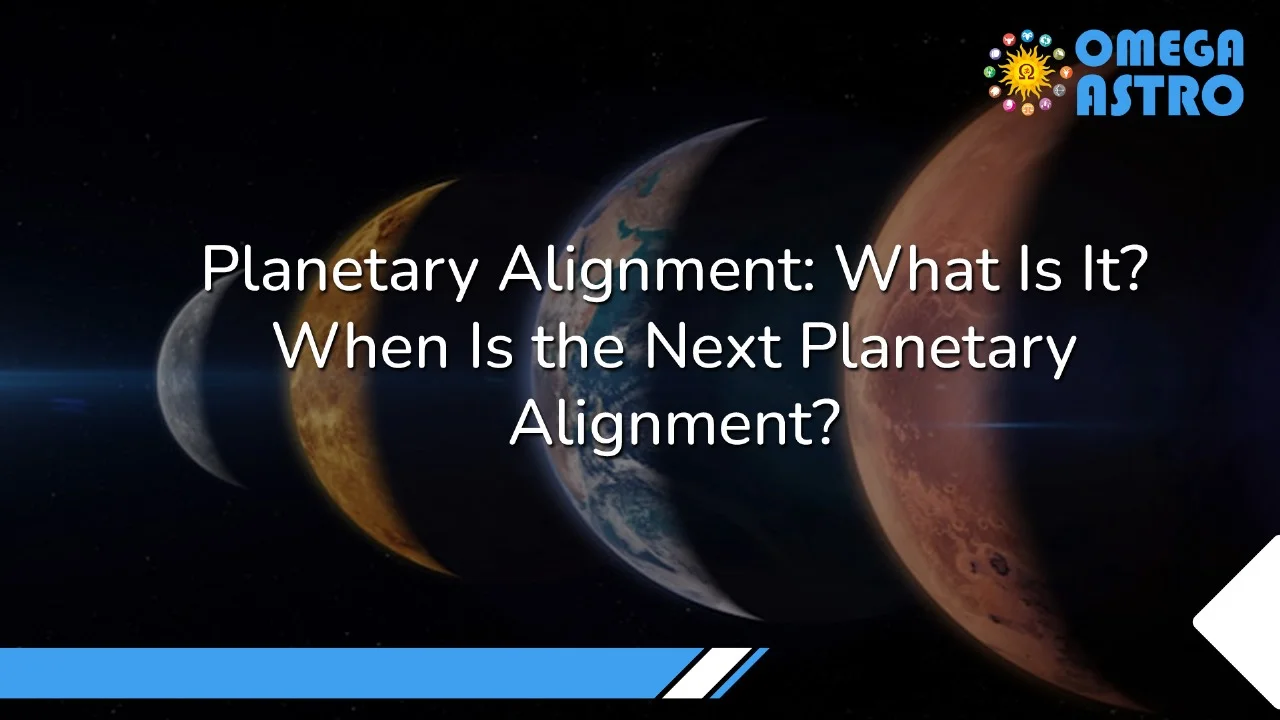
A planetary alignment is when several planets appear close together in the same part of the sky. They are not in a straight line in space.
The next one is around 14 November 2026: Mercury, Venus, Mars and Jupiter, low in the east before sunrise.
There is no major alignment listed for 2030. The next big ones are in 2034 and 2040.
Science says it has no effect on Earth. Astrology reads it through your own kundli, not your sun sign.
You do not need a puja or gemstone because of it. If you want to act, use the simple remedies below.
What is planetary alignment?
It is when three or more planets show up along the same arc of sky as seen from Earth. All planets orbit the Sun in nearly the same flat plane, and from Earth that plane looks like a curved path called the ecliptic. When several planets sit on the same side of the Sun, they land on that path and look lined up.
The orbits are slightly tilted and the planets move at different speeds, so the alignment of planets is never perfect. It looks like a loose arc. Also, Uranus and Neptune are too faint to see without help, which is why websites count the same event as four, five or six planets.
You will also see it called planet alignment, planets alignment or a “cosmic alignment”. These are casual names for the same sky event. An astrological alignment is narrower: planets forming a conjunction or an angle to each other in a chart.
When do the planets align next?
| Date | Planets | Sky |
| 14 Nov 2026 | Mercury, Venus, Mars, Jupiter | Before sunrise |
| 2 Jul 2027 | Mercury, Venus, Saturn, Uranus, Neptune | Before sunrise |
| 25 Dec 2027 | Mercury, Venus, Mars, Saturn, Uranus, Neptune | After sunset |
| Late Oct 2028 | All five naked-eye planets | Before sunrise |
| Feb 2034 | 5 to 7 planets, depending on the count | After sunset |
By Wikipedia’s count, the next six-planet parade after 2025 is in 2040. Dates are the best global dates. Your local best day can be a few days either way.
Is there a planetary alignment in 2030?
No major one, according to NASA’s skywatching page and the Star Walk list as of November 2026. Two planets still meet in the sky several times a year, so a sky app will show smaller events. Ignore any forward that calls 2030 a “once in a lifetime” disaster.
How do I see the 14 November 2026 alignment?
- Be outside 45 to 60 minutes before sunrise.
- Face east and pick a spot with a clear, low horizon. A terrace works better than a lane between buildings.
- Open a free sky app (Star Walk or Stellarium) and point it at the sky to label each planet.
- Spot Venus and Jupiter first, since they are the brightest. Use them to find Mars.
- Look for Mercury last, with binoculars if needed. It stays very low and is the one most people miss.
No telescope is needed. In winter haze, a rooftop usually gives a clearer horizon.
Does planetary alignment affect Earth?
No. Gravity weakens quickly with distance, and the planets are far away and light. Only the Sun and Moon matter for Earth’s tides. NASA has worked out that even at the closest possible alignment, the extra pull would raise a 6-foot tide by about three-thousandths of an inch.
The track record agrees. Writers predicted earthquakes from the 1982 alignment, nothing happened, and they later admitted the error. The 1962 and May 2000 alignments passed quietly too.
What does planetary alignment mean in astrology?
The planets aligning meaning in astrology is personal, not universal. In Jyotish, what matters is the house these planets fall in your chart, not the sky show itself. Planets that look bunched in the sky can sit in different signs, because Jyotish uses the sidereal zodiac. A general “Aries will feel confident” horoscope cannot capture that.
What does the actual kundli of 14 November 2026 look like?
Here is the sky chart for 14 November 2026, 6:00 AM IST, Mumbai, calculated with Swiss Ephemeris and Lahiri ayanamsa. It is the chart of the sky, not of a person.
Kundli chart of the sky on 14 November 2026, 6:00 AM IST, Mumbai, showing Mercury, Venus, Mars and Jupiter
| Planet | Sign (Rashi) | Degree | Nakshatra |
| Lagna | Tula | 16°22′ | Swati |
| Sun | Tula | 27°24′ | Vishakha |
| Mercury | Tula | 10°48′ | Swati |
| Venus | Kanya | 28°37′ | Chitra |
| Mars | Simha | 0°38′ | Magha |
| Jupiter | Simha | 1°27′ | Magha |
| Ketu | Simha | 1°08′ | Magha |
| Moon | Dhanu | 19°35′ | Purva Ashadha |
| Saturn | Meena | 14°20′ | Uttara Bhadrapada |
| Rahu | Kumbha | 1°08′ | Dhanishta |
Three things stand out when you read it:
- The “line-up” is spread over three signs. Venus is in Kanya, Sun and Mercury are in Tula, and Mars and Jupiter are in Simha.
- Mars and Jupiter are within about one degree of each other, with Ketu on top of them. Jyotish texts treat planets this close as a special case (Graha Yuddha, or planetary war), and the traditional name for a Mars-Jupiter pair is Guru-Mangal yoga. Ketu’s presence and the house it falls in change the result.
- The Sun and Venus are both in their traditional debilitation signs (Tula and Kanya). That makes the picture mixed, so a plain “good” or “bad” label would be misleading.
How do I read this against my own kundli?
Find your lagna, then count the houses these signs fall in. For example, for a Mesha (Aries) lagna, Simha is the 5th house (Mars, Jupiter and Ketu sit there), Kanya is the 6th (Venus) and Tula is the 7th (Sun and Mercury). For a Karka (Cancer) lagna, those same planets fall in the 2nd, 3rd and 4th. The planets are the same, but the life area they touch is different for each lagna.
I have noticed that most people only check their sun sign and stop. In Jyotish, the lagna, the house lord and the running dasha tell you far more.
As a celebrity astrologer and Vastu Consultant, I, Saurish Sharma, have guided individuals through various aspects of life using my knowledge of astrology and Vastu Shastra. Being honoured with the prestigious Dadasaheb Phalke Icon Award Films in 2021 has been a significant milestone in my journey. To make my consultations accessible to more people, I serve clients through three branches located in Mumbai, Delhi, and Chandigarh.
What are the remedies for planetary alignment?
None are required. If you want something simple, these are the traditional ones for the planets involved. They are optional and not guaranteed to change anything.
| Planet | Day | Simple remedy |
| Jupiter | Thursday | Donate chana dal or yellow items; respect teachers and elders |
| Mars | Tuesday | Recite the Hanuman Chalisa; donate masoor dal |
| Venus | Friday | Donate white items or rice; be considerate in relationships |
| Mercury | Wednesday | Donate green moong; chant the Budh mantra; keep your word on contracts |
| Ketu | Saturday | Feed a stray dog; quiet time or meditation |
Do not buy a gemstone because of an alignment. A stone should match your own chart, and a wrong one can work against you. Also avoid any “alignment puja” that is sold with fear or a guarantee.
If you would like to know which house these planets touch in your kundli, you can book a consultation with Omega Astro. For a good start date for a new venture, use a proper Shubh Muhurat rather than the alignment date. If you are new to chart reading, our guide to the 12 houses in a Kundali is a good place to begin.
Frequently asked questions
Not because of the alignment. Check the panchang and a muhurat for your city and plans. Alignment dates are not selected for auspicious beginnings.
Count from your lagna. Venus is in Kanya, Sun and Mercury in Tula, and Mars, Jupiter and Ketu in Simha. The house each sign becomes for you is where the effect shows.
Tradition calls it Guru-Mangal yoga and generally sees it as supportive of energy with guidance. Ketu sitting with them and the house they fall in can change the result.
The planets stay in the same signs, but the lagna changes about every two hours and with location. That changes which house each planet falls in.
You can find your houses with a free kundli tool. Judging the dasha and how the houses interact needs a trained reading.